Thursday, March 6, 2014
Winter Landscape Garden Photos The Beauty of Natures Artwork

 |
| Waterfall and White Pine in snow |
 |
| Natures Artwork (after the storm) |
 |
| Snow Covered Weeping Blue Atlas Cedar |
 Magnolia in Snow Magnolia in Snow |
 |
| Snow covered Weeping Norway Spruce |
 |
| Natures Framework (Weeping Youngi Birch in snow) |
 |
| The Quiet of Nature (Blanket covered Dwarf Serbian Spruce) |
 |
| Natures Artwork (Weeping Japanese Maple) |
 |
| Snow topped Montgomery Globe Spruce (grafted) The color of springtime is in the flowers, the color of winter is in the imagination. ~Terri Guillemets "Every gardener knows that under the cloak of winter lies a miracle ... a seed waiting to sprout, a bulb opening to the light, a bud straining to unfurl. And the anticipation nurtures our dream." - Barbara Winkler |


Camassia
Camassia
Camassia cusickii ( Cusick Camass )
Reaches up to 3 x 1.5 feet, and is native to northeastern Oregon.
The foliage is gray-green. The bright blue flowers, up to 1.5 inches across, are borne during mid spring.
Hardy zones 3 to 8 in full sun to partial shade.
Camassia leichtlinii ( Great Camass )
Reaches up to 4 x 1.5 ( rarely over 2 ) feet, and is native to forest edges in western North America ( British Columbia to California ).
The grassy, dense foliage is mid-green.
The foliage goes dormant during late summer.
The blue flowers, up to 3 inches across, are borne on tall spikes during mid spring.
Hardy zones 3 to 8 in full sun to partial shade. Tolerates clay and wet sites that become dry during summer. The bulbs should be planted during autumn and at least 8 inches in depth. It is great for naturalizing.
Alba
White flowers
Blue Danube
Deep blue flowers.
Semiplena
Double flowers.
Camassia quamash ( Common Camass )
Reaches up to 2 x 1 feet, and is native to western North America ( southern British Columbia to southern Alberta; south to northern Oregon and Montana ).
The very narrow foliage is mid-green.
The very showy, blue flowers, up to 1.5 inches across, are borne on large spikes during late spring.
Hardy zones 3 to 8 in full sun to partial shade ( also full shade in deciduous woodlands with late leafing trees ). Tolerates clay and wet sites that become dry during summer.
Read More..
Camassia cusickii ( Cusick Camass )
Reaches up to 3 x 1.5 feet, and is native to northeastern Oregon.
The foliage is gray-green. The bright blue flowers, up to 1.5 inches across, are borne during mid spring.
Hardy zones 3 to 8 in full sun to partial shade.
Camassia leichtlinii ( Great Camass )
Reaches up to 4 x 1.5 ( rarely over 2 ) feet, and is native to forest edges in western North America ( British Columbia to California ).
The grassy, dense foliage is mid-green.
The foliage goes dormant during late summer.
The blue flowers, up to 3 inches across, are borne on tall spikes during mid spring.
Hardy zones 3 to 8 in full sun to partial shade. Tolerates clay and wet sites that become dry during summer. The bulbs should be planted during autumn and at least 8 inches in depth. It is great for naturalizing.
Alba
White flowers
Blue Danube
Deep blue flowers.
Semiplena
Double flowers.
Camassia quamash ( Common Camass )
Reaches up to 2 x 1 feet, and is native to western North America ( southern British Columbia to southern Alberta; south to northern Oregon and Montana ).
The very narrow foliage is mid-green.
The very showy, blue flowers, up to 1.5 inches across, are borne on large spikes during late spring.
Hardy zones 3 to 8 in full sun to partial shade ( also full shade in deciduous woodlands with late leafing trees ). Tolerates clay and wet sites that become dry during summer.
Designing Your Garden
Water-Wise Garden
Beautify your entranceway with a low-maintenance landscape that frees you from the garden hose! This landscape plan makes good use of natural rainfall, so these drought-tolerant plants wont beg for more water.

----------------------------------------------------------------------------------
Color Garden
Immerse yourself in living color! Use this landscape design plan to create an ever-changing tapestry of bold, vibrant hues for your backyard retreat.

----------------------------------------------------------------------------------
Sensory Garden
Wrap your patio in this soothing feast for the senses. Designed to fit alongside any hardscaped surface, this low-maintenance bed offers delightful fragrance, touch and sound plus multi-seasonal beauty and plenty of butterflies.

----------------------------------------------------------------------------------
Meditation Garden
Step away from stress and into your very own garden sanctuary. Use this free landscape plan to create a private retreat thats perfect for a little quiet time.

--------------------------------------------------------------------------------
Fruit Garden
Why not create a beautiful patio getaway that will also supply you with fresh and healthy desserts? Use this free landscape plan to create a sweet retreat close to home!

----------------------------------------------------------------------------------
Herb Garden


Read More..
Beautify your entranceway with a low-maintenance landscape that frees you from the garden hose! This landscape plan makes good use of natural rainfall, so these drought-tolerant plants wont beg for more water.
----------------------------------------------------------------------------------
Color Garden
Immerse yourself in living color! Use this landscape design plan to create an ever-changing tapestry of bold, vibrant hues for your backyard retreat.
----------------------------------------------------------------------------------
Sensory Garden
Wrap your patio in this soothing feast for the senses. Designed to fit alongside any hardscaped surface, this low-maintenance bed offers delightful fragrance, touch and sound plus multi-seasonal beauty and plenty of butterflies.
----------------------------------------------------------------------------------
Meditation Garden
Step away from stress and into your very own garden sanctuary. Use this free landscape plan to create a private retreat thats perfect for a little quiet time.
--------------------------------------------------------------------------------
Fruit Garden
Why not create a beautiful patio getaway that will also supply you with fresh and healthy desserts? Use this free landscape plan to create a sweet retreat close to home!
----------------------------------------------------------------------------------
Herb Garden
Wednesday, March 5, 2014
COUNTDOWN TO CHELSEA FLOWER SHOW 4
Glitz in the Garden. Consider man’s attempt to conquer nature within the landscape as a symbol for wealth and power. Specific oppulent civilizations provide many examples throughout recorded history – as punctuated by Hadrian’s Villa, Versailles, and Hearst Castle.


Garrett Eckbo- “As social inequieties become more complex, those who have more than the average, and more than they need, tend to express or flaunt such surpluses…. For the common man, dish gardens, patios or suburban backyards may provide symbols of memories of the paradise of the rich.”
From the Telegraph, here is this morning’s article on this years 20 million pound show garden, the most expensive in the history of “The Great Show”. (Interestingly, this comes after complaints at last years show that Chelsea had scaled back, reflective of the global recession.)

“David Domoneys design is the most expensive in the events 97 year history.
The Ace of Diamonds garden will be littered with jewels loaned by Bond Street store Leviev. The garden celebrates the links between plants and precious stones and its centrepiece will be diamond jewellery worth millions that will require unprecedented security.
It will boast a £1 million peony-shaped ring with pink and green diamonds and a daisy-shaped ring set with a rare, flawless blue diamond worth £3.2 million.
Domoney, who formerly appeared on ITVs This Morning, also hopes to include an even more valuable uncut diamond in his elaborate, outdoor display.
The garden will be worth more than all Chelseas other collections put together when the Royal Horticulture Societys annual showpiece begins on May 25.
Many of the plants being used by Domoney have gemstones in their names such as euonymous emerald gaiety, potentilla gold finger and hosta diamond tiara.
A looping path of stepping stones leads to a central, diamond-shaped patio. When viewed from above, it is said to look like a pendant necklace.
The garden will boast Chiltern marble, Roman plinths and backlit walls with semi-precious stones such as quartz and amethyst.
The gems will be on display for the gardens launch and the duration of the judging. Domoney, who has previously suggested using Viagra to perk up wilting plants, said: "I always endeavour to introduce something a little bit more entertaining and this garden is something really special.
"I am aiming to give the garden a real James Bond-style feel.
"There will be more bling on display than on Paris Hilton.
"But we will be asking the judges to think of Helen Mirren for a touch of class.
"Its high end and extreme but with a strong horticultural message. Its a jewellery box garden. "This garden will be the most expensive that Chelsea has ever had or is ever likely to have.”
"It will be more valuable than all the rest of Chelsea collections from this year and last year combined." RHS shows director Bob Sweet said: "We are all very excited that this very valuable diamond will be sat on a table in Davids outdoor garden. "We have tight security at Chelsea anyway but something like this will require special attention, which it will definitely get."
Chelseas world-famous show gardens typically cost no more than £250,000.
The Ace of Diamonds is the second of four Domoney gardens designed for airline sponsor BMIs Diamond Club, following on from last years Ace of Spades.
For that, a Harley Davidson motorbike took pride of place in a large pit shaped like a giant ace of spades and lined with recycled garden spades.”

Last years Ace of Spades garden.
Garden Design Trends 2012
 |
| Cleve Wests winning design for Chelsea Flower Show |
Each New Year, the internet is abuzz with it the inevitable horde of prophets and trend-watchers, confidently predicting the themes of the year. Of course, there is absolutely no accountability for these supposed experts because once the buzz of the New Year fades, the predictions are forgotten. I may be one of the few people on the planet who actually loves New Year prognostications. Finding meta-themes from the sea of quotidian activities appeals to my philosophic bent; for me, it is a puzzle game: I love the thrill of finding a pattern among scattered pieces.
So it is with great delight that I present to you my attempt at New Year trend-spotting. This year, my trends focus on trends in garden design (it’s best to stick to what I know, right?). For the last few weeks, I have spent time contemplating great gardens designed in the last year. What was it about these spaces that captured the zeitgeist? What about them moved me? What aspects of them will likely be replicated?

1. The New Romanticism: Garden design in 2012 will mark a return to romanticism. For the last decade, the focus on sustainable gardens has brought a decidedly rationalistic overlay to garden design. After all, the focus on sustainable techniques such as stormwater, native species, and xeriscaping has emphasized scientific and ecological processes. In addition, modernism has been a big theme in garden design over the last decade, bringing with it a focus on functionalistic design. While I expect sustainable and modernistic designs to continue, new gardens will be less cerebral and more emotional and spiritual bent. Expect to see a revival of all sorts of old, classical garden styles such as cottage gardening, French and Italian formal gardens, and even medieval gardens updated with a modern twist. Romanticism is all about nostalgia, escape, and the rich world of the imagination, ideas that are powerfully effective during times of transition. Expect to see gardens that explore fantasy, whimsy, and spontaneity within a framework of familiar garden forms.
Cleve West’s winning design for The Daily Telegraph Garden at last year’s Chelsea Flower Show is a perfect example of neo-romanticism. His sunken garden used terra-cotta columns that evoked Roman ruins. His plantings were both modern and old-world as he relied on a palette of self-seeding plants that emphasize change. The rich overlay of classical ruins in this strongly contemporary garden hinted at a world beyond, a lost history that provides a moment of escape and fantasy that make the garden delightful.
 |
| Left, design by Wirtz International; Center, Piet Oudolfs wave hedges; Right, Tom Stuart-Smith |
2. Creative Hedges: One kind of revivalism that is already making a comeback is hedges and topiary. Clipping shrubs has been somewhat out of style as of late, a sort of high maintenance dinosaur of a less sustainable era. But designers such as the Jacques and Peter Wirtz, Piet Oudolf, and Tom Stuart-Smith have shown the creative potential of hedges clipped in non-traditional forms. Whether it is the Wirtz’s musically inspired hornbeams, Piet Oudolf’s iconic wave hedges, or Tom Stuart-Smith’s cloud hedge, clipped shrubs offer the potential to transform a garden space. These clipped hedges are particularly effective set against a background of herbaceous plantings. Jake Hobson’s recent book, The Art of Creative Pruning (already a best seller at Timber Press), chronicles the many ways clipped shrubs can shape a garden.
3. Moody, Expressive Plantings: This year, designed plantings will be less about color or the expression of space and more about richly evoking a mood, a feeling, an atmosphere. Think about William Turner’s sea paintings or Rothko’s floating squares of colors. Plantings will focus less on some kind of formal arrangement and more on a palette of plants that communicates a feeling, or reminds one of being in some larger landscape.
For example, Tom Stuart-Smith’s 2010 Laurent Perrier garden shows how a palette of low grasses and umbellifer flowers evokes a romantic, woodland landscape. The plantings are restrained, yet they feel like the setting for a fairy-tale. Even within the confines of a few hundred square feet, Stuart-Smith’s composition manipulates our association—our memory—of a woodland grove, thus giving his design an expansive, exultant feeling.
 |
| Laurent Perrier Garden, image from http://www.rhs.org.uk/ |
4. Artisanal Flourish: I predict this year garden design will focus more on artisanal, idiosyncratic details than super-sleek designs. This does not mean modern garden design will go out of style; rather, that even within the framework of modern gardens, the materials and details will rely more on warmer, artisanal constructions. This will be a reaction to both the glut of generic suburban gardens (sea of concrete pavers) and gleaming stainless-steel high end modern gardens that have become ubiquitous.
 |
| Artisanal detail: Reading nook by Nelson, Byrd, Woltz Photo by Eric Piasecki |
5. Heirloom Ornamentals: Grandma’s favorites are hot again. As a reaction to the endless addition of over bred plants (really, do we need any more colored Coral Bells?), gardeners will turn once again to those plants that have withstood the test of time. Boxwoods and Yews, Lilacs and Hydrangeas, Peonies and Daylilies will all feature prominently in this year’s garden designs. Expect to see these nostalgic favorites even in sleeker, modern designs, too. Why should having a well-designed garden mean that we can’t have a few sentimental favorites? I’ve already noticed more niche nurseries in the mid-Atlantic region offering heirloom boxwoods or lilacs. If people are going to spend money on a new garden, they want an emotional attachment to a specific plant. Heirlooms offer just that.
In 2012, romantic is in. I predict a very good year for garden design.
Spring Flowering Trees Pretty in Pink and White
 |
| Spring Flowering Trees |
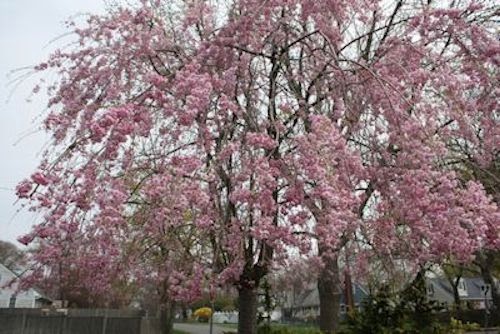 |
| Prunus subhirtella Pendula (Weeping Cherry) Height 15-25 Cold Hardy to Zone 4 Full Sun The first is Prunus subhirtella Pendula, otherwise known as Weeping Cherry. Weeping Cherry is sure to be a favorite in the landscape with its open graceful weeping habit and soft pink flowers to be welcomed in spring. This tree grows to be moderately wide so be sure to give adequate space so that it can spread. I would recommend this tree as a stand alone piece with understory plantings. It looks beautiful as a focal point on a raised berm area and is a show stopper when displayed at the entrance of a property. |
 |
| Prunus serrulata Kwanzan (Kwanzan Cherry) Height 20-30 Cold Hardy to Zone 5 Full Sun |
Next is the well known Kwanzan Cherry. Kwanzan Cherry are magnificent trees producing large double-pink flowers in early spring. The dense vase shaped branch structure of the tree along with its deep mahogany-colored bark makes it majestic. Plant this tree as a single specimen or in a grouping for a more dramatic effect. Kwanzan Cherry is adaptable to seashore conditions and is somewhat drought tolerant. It is definitely a favorite of many a gardener.
 |
| Prunus subhirtella Snofozam (Weeping Snow Fountain Cherry) Height 6-12 Cold Hardy to Zone 4 Full Sun |
Snofozam Cherry is a popular spring flowering tree used in residential landscapes. This smaller variety of Weeping Cherry makes it perfect for smaller apaces. It displays delicate white flowers on cascading branches in early spring. Its compact form and height of 6-12 feet makes it excellent addition as an anchor plant in a foundation planting. I would definitely recommend this tree as a welcomed addition to your landscape.
 |
| Prunus cerasifera Thundercloud (Thundercloud Plum) Height 15-25 Cold Hardy to Zone 4 Full Sun |
 |
| Prunus cerasifera Thundercloud (Thundercloud Plum) Spring Blossom Height 15-25 Cold Hardy to Zone 4 Full Sun |
An extremely versatile tree, Thundercloud Plum displays mildly fragrant light pink flowers in spring followed by deep burgundy foliage that lasts well into fall. This tree has attributes that continue throughout the entire season. Display Thundercloud Plum as a single anchor specimen in a foundation planting or in a group planting such as on a raised island bed. It will be sure to add years of enjoyment to your landscape.
Star Magnolia displays fragrant white star-like flowers in early spring followed by green foliage. Magnolia Royal Star grows as wide as it is tall and can be regularly pruned to keep a compact shape. This tree fits in very nicely as as addition to a poolscape garden as seen here and will welcome spring with its wonderful fragrance. Magnolia forms catkin-looking buds in late winter which are an additional attribute.
 |
| Magnolia stellata Royal Star (Star Magnolia) Height 12-20 Cold Hardy to Zone 4 Full Sun |
 |
| Magnolia stellata Royal Star (Star Magnolia) Spring Blossom Height 12-20 Cold Hardy to Zone 4 Full Sun |
 |
| Magnolia liliflora Jane (Lily Magnolia) Height 10-12 Cold Hardy to Zone 5 Full Sun This beautiful more upright form of Magnolia displays fragrant purple and white tulip-shaped flowers in May followed by deep green foliage and on a rounded branch structure. It serves nicely as a stand alone piece or in a woodland garden setting. Its delicate and beautiful blooms make it a conversation piece in the garden. |
 |
| Pyrus calleryana Cleveland Select (Ornamental Pear) Height 25-40 Cold Hardy to Zone 5 Full Sun  Height 25-40 Cold Hardy to Zone 5 Full Sun Ornamental Pear has become a popular landscape plant in both commercial and residential areas over the past several years. Traditionally Bradford Pear was the species widely planted but has been found to notorious for overweight branches that break in high winds. An improved variety known as Cleveland Select displays a more narrow upright form that is superior for flower production and better structure. The tree is covered in pure white blossoms in early spring followed by green foliage throughout the rest of the season. Ornamental Pear display nicely as a single specimen planting or planted in groupings for maximum impact.  Height 15-20 Cold Hardy to Zone 5 Full Sun to Partial Shade Pink Flowering Dogwood is the smaller more upright form of Dogwood displaying large pink flowers before leafing out in early spring followed by small red fruit in early fall. It complements a natural woodland setting beautifully either as a single specimen planting or in a group planting. |

Cornus Kousa (Japanese Dogwood)
Height 20-25
Cold Hardy to Zone 5
Full Sun to Partial Shade
Japanese Dogwood is a beautiful late spring-early summer flowering tree that can be used in a variety of landscape settings. The tree has a characteristic rounded appearance at maturity and displays long lasting flat white flowers that give way to rounded strawberry-like fruit in fall. Kousa Dogwood has proven to be more disease resistant than the pink variety and is the perfect size to be used as an anchor tree in a foundation planting and also serves nicely as part of a natural woodland planting. It is sure to fit into a variety of landscapes and supply years of enjoyment.
To welcome spring with early blooms and fragrance try adding one or more of these beautiful trees to your outdoor space. They will be sure to supply years of enjoyment and be a welcomed sight when the warm weather arrives.
As Always...Happy Gardening!
Author: Lee@A Guide To Northeastern Gardening, Copyright 2013. All rights reserved

Tuesday, March 4, 2014
Calamint
Calamintha
A small genus of perennials, that are part of the greater Labiatae family. They are closely related to the Mint but are not invasive.
Calamintha grandiflora ( Showy Calamint )
Also called Satureja grandiflora. A very vigorous, spreading perennial, reaching a maximum size of 3 x 4 ( rarely over 3 ) feet, that is native to southern Europe.
The toothed, ovate leaves, up to 3.2 x 2.7 inches, are mid-green. The foliage is aromatic and can be used in cooking.
The pink or bright purple, tubular flowers, up to 1.3 inches in length, resemble that of Salvia and are borne all summer long.
Hardy zones 3 to 7 in full sun to partial shade. It is easy to grow on just about any well drained soil.
Variegata
Very vigorous, spreading, but upright bushy perennial, reaching up to 2 x 3 feet. The foliage is variegated with creamy-white splashing. The bright pink flowers, up to 1.5 inches across, are somewhat sporadic.
Calamintha nepeta ( Lesser Calamint )
A perennial, reaching a maximum size of 32 inches x 5 feet, that is native to the British Isles and southern Europe. Great for the front of the border and edging pathways, it is not invasive. Makes an excellent groundcover.
The small, gray-green, ovate leaves, up to 3 ( often half that ) inches in length, are minty fragranced. The aromatic foliage is often used in italian cooking.
The profuse, pale lilac flowers are borne on upright stems over a long season from early summer to mid autumn. The flowers attract hummingbirds and butterflies.
Hardy zones 4 to 7 in full sun to partial shade on well drained soil.
Drought tolerant. Powdery mildew may sometimes be a problem.
* photo taken on Aug 2 2011 in Hyde Park, NY

* photos taken on Aug 25 2011 @ Scott Arboretum, Swarthmore College, PA


Blue Cloud
Reaches a maximum size of 1.5 x 5 feet, bearing tiny, lavender-blue flowers; otherwise similar.
Gottlieb Friedkund
Reaches up to 2 x 2.5 feet with large, deep green leaves and deep lavender flowers borne over a long season.
subsp nepeta
Low and spreading, reaching up to 20 inches x 5 feet, with aromatic foliage and abundant, small, pale blue flowers borne on plumes from early summer to mid autumn.
* photos of unknown internet source


White Cloud
Reaches a maximum size of 1.5 x 5 feet, bearing white flowers; otherwise similar.
Read More..
A small genus of perennials, that are part of the greater Labiatae family. They are closely related to the Mint but are not invasive.
Calamintha grandiflora ( Showy Calamint )
Also called Satureja grandiflora. A very vigorous, spreading perennial, reaching a maximum size of 3 x 4 ( rarely over 3 ) feet, that is native to southern Europe.
The toothed, ovate leaves, up to 3.2 x 2.7 inches, are mid-green. The foliage is aromatic and can be used in cooking.
The pink or bright purple, tubular flowers, up to 1.3 inches in length, resemble that of Salvia and are borne all summer long.
Hardy zones 3 to 7 in full sun to partial shade. It is easy to grow on just about any well drained soil.
Variegata
Very vigorous, spreading, but upright bushy perennial, reaching up to 2 x 3 feet. The foliage is variegated with creamy-white splashing. The bright pink flowers, up to 1.5 inches across, are somewhat sporadic.
Calamintha nepeta ( Lesser Calamint )
A perennial, reaching a maximum size of 32 inches x 5 feet, that is native to the British Isles and southern Europe. Great for the front of the border and edging pathways, it is not invasive. Makes an excellent groundcover.
The small, gray-green, ovate leaves, up to 3 ( often half that ) inches in length, are minty fragranced. The aromatic foliage is often used in italian cooking.
The profuse, pale lilac flowers are borne on upright stems over a long season from early summer to mid autumn. The flowers attract hummingbirds and butterflies.
Hardy zones 4 to 7 in full sun to partial shade on well drained soil.
Drought tolerant. Powdery mildew may sometimes be a problem.
* photo taken on Aug 2 2011 in Hyde Park, NY
* photos taken on Aug 25 2011 @ Scott Arboretum, Swarthmore College, PA
Blue Cloud
Reaches a maximum size of 1.5 x 5 feet, bearing tiny, lavender-blue flowers; otherwise similar.
Gottlieb Friedkund
Reaches up to 2 x 2.5 feet with large, deep green leaves and deep lavender flowers borne over a long season.
subsp nepeta
Low and spreading, reaching up to 20 inches x 5 feet, with aromatic foliage and abundant, small, pale blue flowers borne on plumes from early summer to mid autumn.
* photos of unknown internet source
White Cloud
Reaches a maximum size of 1.5 x 5 feet, bearing white flowers; otherwise similar.
Subscribe to:
Posts (Atom)